Філоксера знищила виноградники Європи, а відповідь прийшла з долини Târnava: американська підщепа, щеплення, школи лози й система продажу, яка занесла лозу на станції монархії.
6 хв читання
Phylloxera destroyed the vineyards of Europe, and the answer came from the Târnava valley: American rootstock, grafting, vine schools and a sales system that carried vines into the stations of the monarchy.
Phylloxera
On his return from Klosterneuburg, Friedrich Caspari finds the vineyards of Europe and of the Mediaș area laid waste by phylloxera. This is not a local crisis: the insect, which had arrived from North America, was destroying European vineyards, and in Transylvania its effects become so grave that replanting can no longer be left to each owner. A state office is created, and the discussion moves from «what do we do with the vine» to «who is responsible for restoring the vineyards». In this context a teacher with a bent for agronomy and a merchant with ambition suddenly become people of public importance. The documents preserve the moment: an article signed by Friedrich Caspari as commissioner for phylloxera of Târnava Mare County.
The commissioner
Caspari applies for the post of commissioner for combating phylloxera in Transylvania, is accepted and receives a salary of 2,000 crowns a year. For ten years he replants vineyards, forms and trains viticulturists, holds lectures and searches for the ideal solution. This is the period in which he learns the problem at scale — not just how to plant a vineyard but how to restore a region. A solution is found, but he cannot use it: it would be a conflict of interest between the public office and his own business. That is why the dissolution of the post in 1902 is experienced by him as a relief, not a loss. From that moment he can do what he had long wanted: plant his own vine school.
1902: American grafting
In 1902 Caspari takes the biggest risk of his life: he imports American grafted vines in order to produce them himself and multiply them in large quantities. The technical stake is simple and enormous: the American rootstock resists phylloxera, the European graft gives the wine. The risk pays off — his deposits come to hold up to four million grafted vines, and he becomes one of the richest men in Mediaș. But above all he gains a title: «viticulture pioneer», because after planting the rootstock gardens he established vineyard schools for grafted vines. This is the moment when a producer becomes a technical school.
The nursery of the Kokel valley
The institution has a name that fixes the place: «Kokeltaler erste Rebveredlungs-Anlage» — the first vine-grafting facility of the Kokel valley, that is of the Târnava valley, under the trade name Caspari Fr. The name appears on the price catalogue and on the billboard, in German and in Hungarian: «A kőkellemti első szőlőoltványtelep». It is a case of agro-industrial branding avant la lettre: not «Caspari's nurseries» but «the first grafting facility» of an entire valley. What comes out of this facility is not only vines but trained people, a price catalogue with two hemispheres on its cover and a network of vine schools. In the drought years Caspari also solves water: he builds a water wheel on the Bulgarian model and brings water from the Târnava through channels kilometres long.
The export
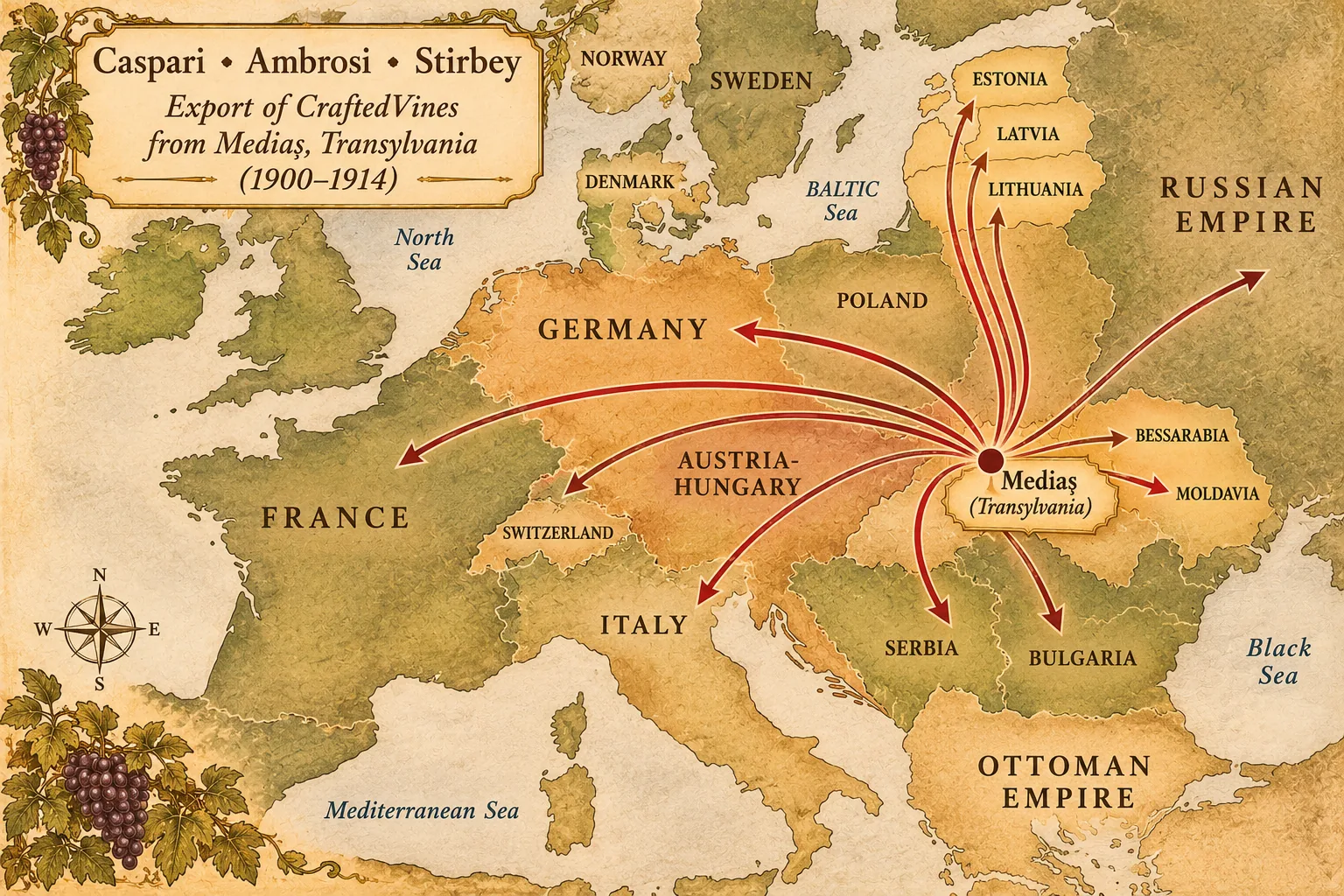
The sales network is the most spectacular part of the file. Caspari places his billboard with the earth globe and the vine in most train stations of the monarchy, publishes announcements in every specialist magazine and distributes thousands of catalogues each year, with prices for all the important wine-growing regions of Europe. He delivers by train wagon towards Austria, Hungary, Oltenia and even Russia, almost reaching the border of Asia. Before the First World War he owns 1,000 yokes of open field, extending as far as Oltenia, where he has branches of the company. Orders come from barons and princes: Inczedy, Liechtenstein, Szapary, Bussell — whose letters are reproduced in the catalogue. In 1939–1940 and 1940–1941 the house’s catalogues are still being printed, now under the name «Caspari, successor Iosif Höfner».
Caspari–Ambrosi–Știrbey · Export 1900–1914
Știrbey, Ambrosi and the road to Romania
The house’s Romanian connection runs through the nurseries of Prince Barbu Știrbey. In 1905 «Furnica» magazine publishes an advertisement for the American vine nurseries at Drăgășani, «under the direction of Mr. Fr. Caspari (Mediaș)»: vines with «a high take, vigour, absolute graft union», delivered free to any railway station, with free packaging, through a central sales office in Bucharest, Calea Victoriei 121.
In the same year the nurseries print their preface in a railway timetable: «Entering the third year of our nurseries’ existence…». The text describes stratification grafting, the selection of rootstocks and Romanian grafts, and advertises the ungrafted vines from the «great mother nurseries» on the Buftea estate. A dispatch note of the Știrbey nurseries at Buftea — form no. 2588, with fields for advance, cash on delivery and credit — preserves the vines’ journey by rail to Mediaș. In the 1907–1908 catalogue Caspari presented himself as «diploma oenologist, director of the vine plantations of Prince Barbu A. Știrbey in Romania, former viticulture commissioner of Târnava Mare county»; in 1931 the booklet «Planting and caring for the vineyards» called him «the former director of the vine nurseries of Prince Știrbey in Romania».
In the same town Michael Ambrosi Sen. (1862–1933) builds a parallel business: president of the Viticulture Commission, author of «Podgoreanul. Priceput Călăuză» (1906, 1913) and of leaflets on a new grafting process (1910, revised 1928), «associated with and director of the nurseries of Prince B. Știrbey at Buftea» and author of the article on the Știrbey nurseries at Buftea (1909). At Aiud, in Alba, the Ambrosi & Fischer nursery operated, and in the early 1920s Ambrosi gave Fetească regală its name. The book speaks of «the two pioneers of replanting Europe with grafted vines, Caspari and Ambrosi».
Люди
Ті, хто носив ім’я
21 octombrie 1858–1935
Friedrich Caspari
Виноградар, учитель, комісар із боротьби з філоксерою в Трансильванії
Друга дитина торговця текстилем Carl Josef Caspari, народжена в Mediaș 21 жовтня 1858 року. Євангельська гімназія в Mediaș (1877), рік військової служби, лейтенант резерву (1879), Педагогічний коледж у Sibiu, десять років приватного вчителювання за 400 флоринів на рік і викладання в професійній школі між 1884 і 1890 роками. 1891 року, у 33 роки, за один рік закінчує виноградарський коледж під Віднем. Стає комісаром із філоксери Трансильванії з окладом 2000 крон на рік, а від 1902 року — власником щеплювального закладу в долині Kokel, імпортером і виробником щепленої американської лози, маючи до чотирьох мільйонів чубуків у сховищах. 1907 року він викуповує батьківський будинок на вулиці Honterus. Каталог 1907–1908 років представляє його як «директора виноградних насаджень князя Barbu A. Știrbey у Румунії». Брошура дому називає його «професор, дипломований енолог, директор погребів князя Știrbey, член-експерт Саксонської винної комісії, виноградар і комісар із боротьби з філоксерою».
Торговець текстилем з Mediaș, батько Friedrich Caspari
Торговець текстилем з Mediaș і батько Friedrich Caspari. 1868 року, коли синові виповнилося десять, він почав будувати власний дім на вулиці Honterus. Його доброта й розуміюча вдача призвели до втрати дому, ділянки й механічного млина — моменту, який запустив обіцянку хлопчика повернути дім у родину. Дати його народження й смерті невідомі, і в джерелах він постає лише через ці два факти.
Дружина Carl Josef Caspari і мати Friedrich. Брошура дому описує її однією деталлю, але вирішальною: вона мала веселу й жартівливу вдачу, наповнювала дім своїм голосом, тож діти ніколи не відчували фінансових проблем родини. Разом із чоловіком, який відмовлявся від ролі суворого батька, вона виховувала дітей із любов’ю й повагою до традиції. Дати її народження й смерті невідомі, як і дівоче прізвище.
Двоюрідна сестра й дружина Friedrich Caspari, співробітниця у справі
Двоюрідна сестра й дружина Friedrich Caspari. Її внесок задокументований як частина справи: вона допомагала йому керувати фірмою, а поряд із першими складськими будівлями з’явилися льохи для зберігання вина й склади для ящиків. Брошура не подає інших даних — ні року шлюбу, ні років життя, ні дітей. У реконструкції вона залишається одним із небагатьох жіночих імен у справі Caspari і єдиним, що прямо постає у виробничій частині справи.
Остання нащадка родини в Mediaș, почесна громадянка муніципію
Остання нащадка родини Caspari в Mediaș і почесна громадянка муніципію Mediaș. 2005 року, під час ремонту дому Buresch у центральній частині, вона розповіла авторові частину історії родини й довірила перші документи — момент, з якого почалася вся реконструкція. Книжку видано в її пам’ять: «пані Maia Caspari, почесна громадянка муніципію Mediaș, остання представниця родини в цій місцевості, якої, на жаль, уже немає серед нас». Брошура дому називає її «Mariane Caspari»; обидві форми є в томі й потребують підтвердження в клієнта.
Виноградар, голова Виноградарської комісії, автор книжок із виноградарства
Другий піонер повторного засадження Європи щепленою лозою, сучасник і земляк Friedrich Caspari. Він був головою Виноградарської комісії, звіт якої за 1909 рік зберігся, власником розсадників і погребів Ambrosi в Mediaș і автором книжки «Podgoreanul. Priceput Călăuză» (1906; 1913), листівок про «новий спосіб щеплення» (1910, перегляд 1928) і статті «Розсадники князя Știrbey у Buftea» (1909). У книжці він був «співвласником і директором розсадників князя B. Știrbey у Buftea». Його нащадки постають у томі: Michael Ambrosi Jun. (1880–1940), Dr. Alfred Ambrosi (1895–1974) і Hans Ambrosi (1925–2012). На початку 1920-х він дав назву Fetească regală, а в Alba, в Aiud, працював розсадник Ambrosi & Fischer.
Румунський князь, власник розсадників американської лози в Drăgășani і маєтку Buftea
Румунський князь, чиє ім’я з’являється на документах, що пов’язують дім Caspari з Румунією. Його розсадниками американської лози в Drăgășani 1905 року керував «пан Fr. Caspari (Mediaș)»: оголошення в «Furnica», обкладинка й передмова залізничного розкладу від червня 1905 року кажуть це щоразу. У маєтку Buftea були материнські розсадники, звідки приходили нещеплені лози, а накладна розсадників Știrbey Buftea зберігає їхній шлях до Mediaș. У каталозі 1907–1908 років Caspari представляється директором виноградних насаджень князя Barbu A. Știrbey у Румунії. Джерела не подають дат життя князя.
Ім’я, яке переймає фірму після Friedrich Caspari. Каталоги 1939/1940 і 1940/1941 років показують його як наступника розсадника: «Rebschule Caspari, Nachf. Josef Höfner» і «Pepiniera Caspari succesor Iosif Höfner», з бюро в București, Str. Sirenelor 29, і розсадником у Mediaș, Str. Nouă 3. Бланк замовлення бухарестської філії зберігає ту саму формулу. Джерела не подають біографічних даних.