Phylloxera destroyed the vineyards of Europe, and the answer came from the Târnava valley: American rootstock, grafting, vine schools and a sales system that carried vines into the stations of the monarchy.
6 min read
Phylloxera destroyed the vineyards of Europe, and the answer came from the Târnava valley: American rootstock, grafting, vine schools and a sales system that carried vines into the stations of the monarchy.
Phylloxera
On his return from Klosterneuburg, Friedrich Caspari finds the vineyards of Europe and of the Mediaș area laid waste by phylloxera. This is not a local crisis: the insect, which had arrived from North America, was destroying European vineyards, and in Transylvania its effects become so grave that replanting can no longer be left to each owner. A state office is created, and the discussion moves from «what do we do with the vine» to «who is responsible for restoring the vineyards». In this context a teacher with a bent for agronomy and a merchant with ambition suddenly become people of public importance. The documents preserve the moment: an article signed by Friedrich Caspari as commissioner for phylloxera of Târnava Mare County.
The commissioner
Caspari applies for the post of commissioner for combating phylloxera in Transylvania, is accepted and receives a salary of 2,000 crowns a year. For ten years he replants vineyards, forms and trains viticulturists, holds lectures and searches for the ideal solution. This is the period in which he learns the problem at scale — not just how to plant a vineyard but how to restore a region. A solution is found, but he cannot use it: it would be a conflict of interest between the public office and his own business. That is why the dissolution of the post in 1902 is experienced by him as a relief, not a loss. From that moment he can do what he had long wanted: plant his own vine school.
1902: American grafting
In 1902 Caspari takes the biggest risk of his life: he imports American grafted vines in order to produce them himself and multiply them in large quantities. The technical stake is simple and enormous: the American rootstock resists phylloxera, the European graft gives the wine. The risk pays off — his deposits come to hold up to four million grafted vines, and he becomes one of the richest men in Mediaș. But above all he gains a title: «viticulture pioneer», because after planting the rootstock gardens he established vineyard schools for grafted vines. This is the moment when a producer becomes a technical school.
The nursery of the Kokel valley
The institution has a name that fixes the place: «Kokeltaler erste Rebveredlungs-Anlage» — the first vine-grafting facility of the Kokel valley, that is of the Târnava valley, under the trade name Caspari Fr. The name appears on the price catalogue and on the billboard, in German and in Hungarian: «A kőkellemti első szőlőoltványtelep». It is a case of agro-industrial branding avant la lettre: not «Caspari's nurseries» but «the first grafting facility» of an entire valley. What comes out of this facility is not only vines but trained people, a price catalogue with two hemispheres on its cover and a network of vine schools. In the drought years Caspari also solves water: he builds a water wheel on the Bulgarian model and brings water from the Târnava through channels kilometres long.
The export
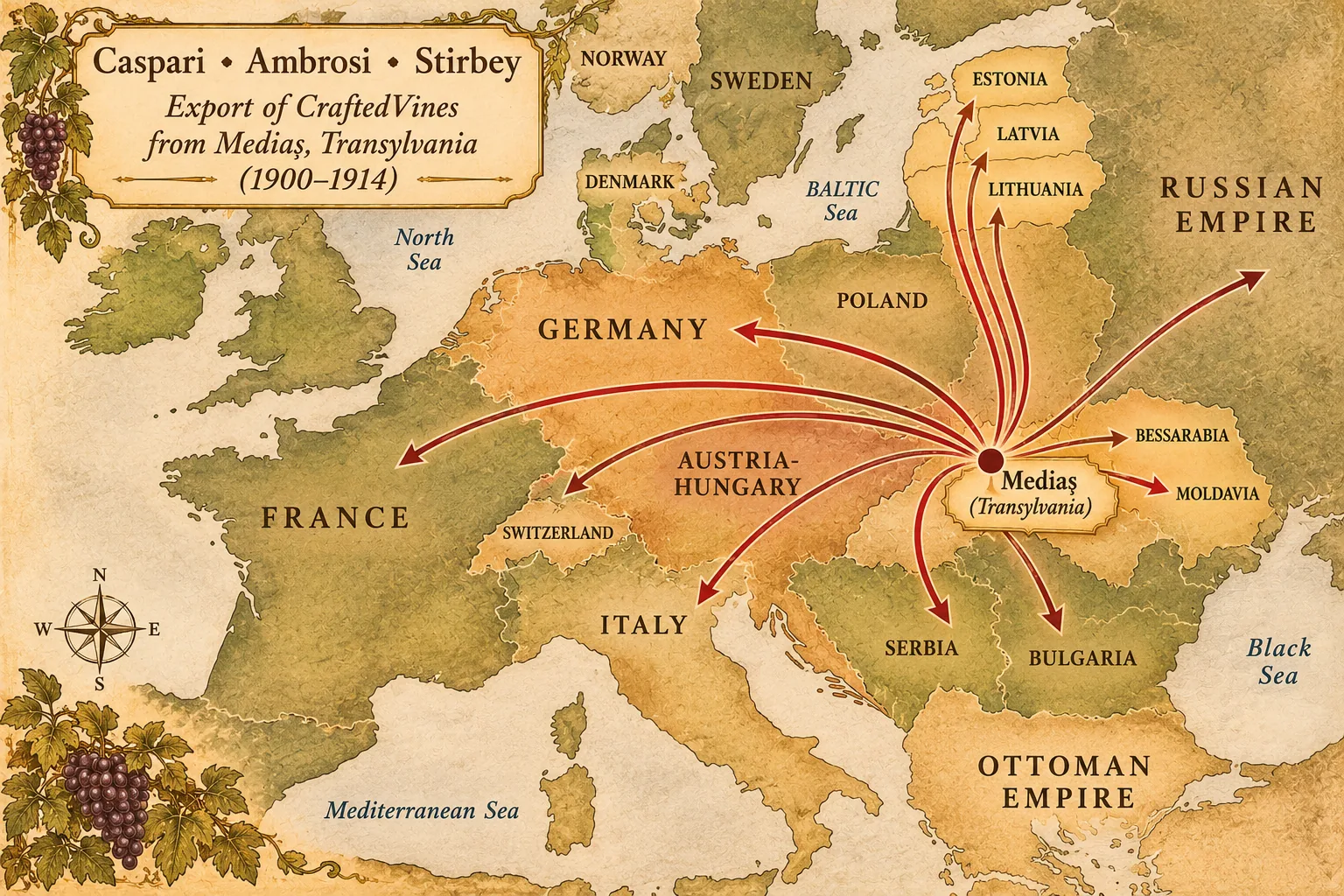
The sales network is the most spectacular part of the file. Caspari places his billboard with the earth globe and the vine in most train stations of the monarchy, publishes announcements in every specialist magazine and distributes thousands of catalogues each year, with prices for all the important wine-growing regions of Europe. He delivers by train wagon towards Austria, Hungary, Oltenia and even Russia, almost reaching the border of Asia. Before the First World War he owns 1,000 yokes of open field, extending as far as Oltenia, where he has branches of the company. Orders come from barons and princes: Inczedy, Liechtenstein, Szapary, Bussell — whose letters are reproduced in the catalogue. In 1939–1940 and 1940–1941 the house’s catalogues are still being printed, now under the name «Caspari, successor Iosif Höfner».
Caspari–Ambrosi–Știrbey · Export 1900–1914
Știrbey, Ambrosi and the road to Romania
The house’s Romanian connection runs through the nurseries of Prince Barbu Știrbey. In 1905 «Furnica» magazine publishes an advertisement for the American vine nurseries at Drăgășani, «under the direction of Mr. Fr. Caspari (Mediaș)»: vines with «a high take, vigour, absolute graft union», delivered free to any railway station, with free packaging, through a central sales office in Bucharest, Calea Victoriei 121.
In the same year the nurseries print their preface in a railway timetable: «Entering the third year of our nurseries’ existence…». The text describes stratification grafting, the selection of rootstocks and Romanian grafts, and advertises the ungrafted vines from the «great mother nurseries» on the Buftea estate. A dispatch note of the Știrbey nurseries at Buftea — form no. 2588, with fields for advance, cash on delivery and credit — preserves the vines’ journey by rail to Mediaș. In the 1907–1908 catalogue Caspari presented himself as «diploma oenologist, director of the vine plantations of Prince Barbu A. Știrbey in Romania, former viticulture commissioner of Târnava Mare county»; in 1931 the booklet «Planting and caring for the vineyards» called him «the former director of the vine nurseries of Prince Știrbey in Romania».
In the same town Michael Ambrosi Sen. (1862–1933) builds a parallel business: president of the Viticulture Commission, author of «Podgoreanul. Priceput Călăuză» (1906, 1913) and of leaflets on a new grafting process (1910, revised 1928), «associated with and director of the nurseries of Prince B. Știrbey at Buftea» and author of the article on the Știrbey nurseries at Buftea (1909). At Aiud, in Alba, the Ambrosi & Fischer nursery operated, and in the early 1920s Ambrosi gave Fetească regală its name. The book speaks of «the two pioneers of replanting Europe with grafted vines, Caspari and Ambrosi».
The people
Those who carried the name
21 octombrie 1858–1935
Friedrich Caspari
Viticulturist, teacher, commissioner for combating phylloxera in Transylvania
The second child of the textile merchant Carl Josef Caspari, born in Mediaș on 21 October 1858. The Evangelical Gymnasium in Mediaș (1877), a year of military service, lieutenant in reserve (1879), the Pedagogic College in Sibiu, ten years as a private tutor on 400 florins a year and teaching in a vocational school between 1884 and 1890. In 1891, aged 33, he finishes the viticulture college near Vienna in a single year. He becomes commissioner for phylloxera in Transylvania on 2,000 crowns a year, then, from 1902, owner of the grafting facility in the Kokel valley, importer and producer of American grafted vines, with up to four million vines in his deposits. In 1907 he buys back his parental house on Honterus Street. The house's brochure calls him «professor, diplomat oenologist, director of Prince Stirbey wineries, expert member of the Saxon Wine Commission, viticulturist and commissioner for combating phylloxera».
Textile merchant of Mediaș, father of Friedrich Caspari
A textile merchant of Mediaș and the father of Friedrich Caspari. In 1868, when his son turned ten, he began to build his own house on Honterus Street. His kindness and understanding nature led to the loss of the house, the land and the mechanical mill — the moment that triggered the boy's promise to bring the house back into the family. His dates of birth and death are not known, and he appears in the sources only through these two facts.
The wife of Carl Josef Caspari and the mother of Friedrich. The house's brochure describes her through a single detail, but a decisive one: she had a jolly and amusing temper and filled the house with her voice, so that the children never felt the family's financial troubles. Together with her husband, who refused the role of a severe father, she raised her children with love and respect for tradition. Her dates of birth and death are not known, nor is her maiden name.
Cousin and wife of Friedrich Caspari, collaborator in the business
The cousin and wife of Friedrich Caspari. Her contribution is documented as part of the business: she helped him run the firm, and next to the first storage buildings cellars for keeping the wine and warehouses for boxes appeared. The brochure gives no other details — no year of marriage, no life dates, no children. In the reconstruction she remains one of the few women's names in the Caspari file and the only one that appears explicitly in the production side of the business.
The last descendant of the family in Mediaș, honorary citizen of the municipality
The last descendant of the Caspari family in Mediaș and an honorary citizen of Mediaș Municipality. In 2005, during the renovation of the Buresch house in the central area, she told the author part of the family history and entrusted him with the first documents — the moment from which the whole reconstruction began. The book is published in her memory: «Mrs. Maia Caspari, honorary citizen of Mediaș Municipality, the last descendant of the family in the area, who, unfortunately, is no longer with us». The house's brochure calls her «Mariane Caspari»; both forms appear in the volume and must be confirmed with the client.
Viticulturist, president of the Viticulture Commission, author of viticulture books
The second pioneer of replanting Europe with grafted vines, a contemporary and fellow townsman of Friedrich Caspari. He was president of the Viticulture Commission, whose 1909 report is preserved, owner of the Ambrosi nurseries and cellars in Mediaș and author of «Podgoreanul. Priceput Călăuză» (1906; 1913), of leaflets on «a new grafting process» (1910, revised 1928) and of the article «Prince Stirbey's Nurseries from Buftea» (1909). In the book he was «associated with and director of the nurseries of Prince B. Știrbey in Buftea». His descendants appear in the volume: Michael Ambrosi Jun. (1880–1940), Dr. Alfred Ambrosi (1895–1974) and Hans Ambrosi (1925–2012). In the early 1920s he gave Fetească regală its name, and at Aiud, in Alba, the Ambrosi & Fischer nursery operated.
Romanian prince, owner of the American vine nurseries at Drăgășani and of the Buftea estate
The Romanian prince whose name appears on the documents linking the Caspari house to Romania. His American vine nurseries at Drăgășani were directed, in 1905, by «Mr. Fr. Caspari (Mediaș)»: the advertisement in «Furnica», the cover and the preface of the June 1905 railway timetable say so each time. The mother nurseries from which the ungrafted vines came stood on the Buftea estate, and a dispatch note of the Știrbey nurseries at Buftea preserves their journey to Mediaș. In the 1907–1908 catalogue Caspari presents himself as director of the vine plantations of Prince Barbu A. Știrbey in Romania. The sources give no life dates for the prince.
The successor of the Caspari firm in Mediaș, 1939–1941
The name that takes over the firm after Friedrich Caspari. The 1939/1940 and 1940/1941 catalogues show him as the nursery’s successor: «Rebschule Caspari, Nachf. Josef Höfner» and «Pepiniera Caspari succesor Iosif Höfner», with an office in Bucharest, Str. Sirenelor 29, and the nursery in Mediaș, Str. Nouă 3. An order form of the Bucharest branch preserves the same formula. The sources give no biographical dates.