A filoxéra elpusztította Európa szőlőhegyeit, a válasz pedig a Târnava völgyéből jött: amerikai alany, oltás, szőlőiskolák és olyan értékesítési rendszer, amely a monarchia pályaudvaraira vitte a vesszőt.
6 perc olvasás
Phylloxera destroyed the vineyards of Europe, and the answer came from the Târnava valley: American rootstock, grafting, vine schools and a sales system that carried vines into the stations of the monarchy.
Phylloxera
On his return from Klosterneuburg, Friedrich Caspari finds the vineyards of Europe and of the Mediaș area laid waste by phylloxera. This is not a local crisis: the insect, which had arrived from North America, was destroying European vineyards, and in Transylvania its effects become so grave that replanting can no longer be left to each owner. A state office is created, and the discussion moves from «what do we do with the vine» to «who is responsible for restoring the vineyards». In this context a teacher with a bent for agronomy and a merchant with ambition suddenly become people of public importance. The documents preserve the moment: an article signed by Friedrich Caspari as commissioner for phylloxera of Târnava Mare County.
The commissioner
Caspari applies for the post of commissioner for combating phylloxera in Transylvania, is accepted and receives a salary of 2,000 crowns a year. For ten years he replants vineyards, forms and trains viticulturists, holds lectures and searches for the ideal solution. This is the period in which he learns the problem at scale — not just how to plant a vineyard but how to restore a region. A solution is found, but he cannot use it: it would be a conflict of interest between the public office and his own business. That is why the dissolution of the post in 1902 is experienced by him as a relief, not a loss. From that moment he can do what he had long wanted: plant his own vine school.
1902: American grafting
In 1902 Caspari takes the biggest risk of his life: he imports American grafted vines in order to produce them himself and multiply them in large quantities. The technical stake is simple and enormous: the American rootstock resists phylloxera, the European graft gives the wine. The risk pays off — his deposits come to hold up to four million grafted vines, and he becomes one of the richest men in Mediaș. But above all he gains a title: «viticulture pioneer», because after planting the rootstock gardens he established vineyard schools for grafted vines. This is the moment when a producer becomes a technical school.
The nursery of the Kokel valley
The institution has a name that fixes the place: «Kokeltaler erste Rebveredlungs-Anlage» — the first vine-grafting facility of the Kokel valley, that is of the Târnava valley, under the trade name Caspari Fr. The name appears on the price catalogue and on the billboard, in German and in Hungarian: «A kőkellemti első szőlőoltványtelep». It is a case of agro-industrial branding avant la lettre: not «Caspari's nurseries» but «the first grafting facility» of an entire valley. What comes out of this facility is not only vines but trained people, a price catalogue with two hemispheres on its cover and a network of vine schools. In the drought years Caspari also solves water: he builds a water wheel on the Bulgarian model and brings water from the Târnava through channels kilometres long.
The export
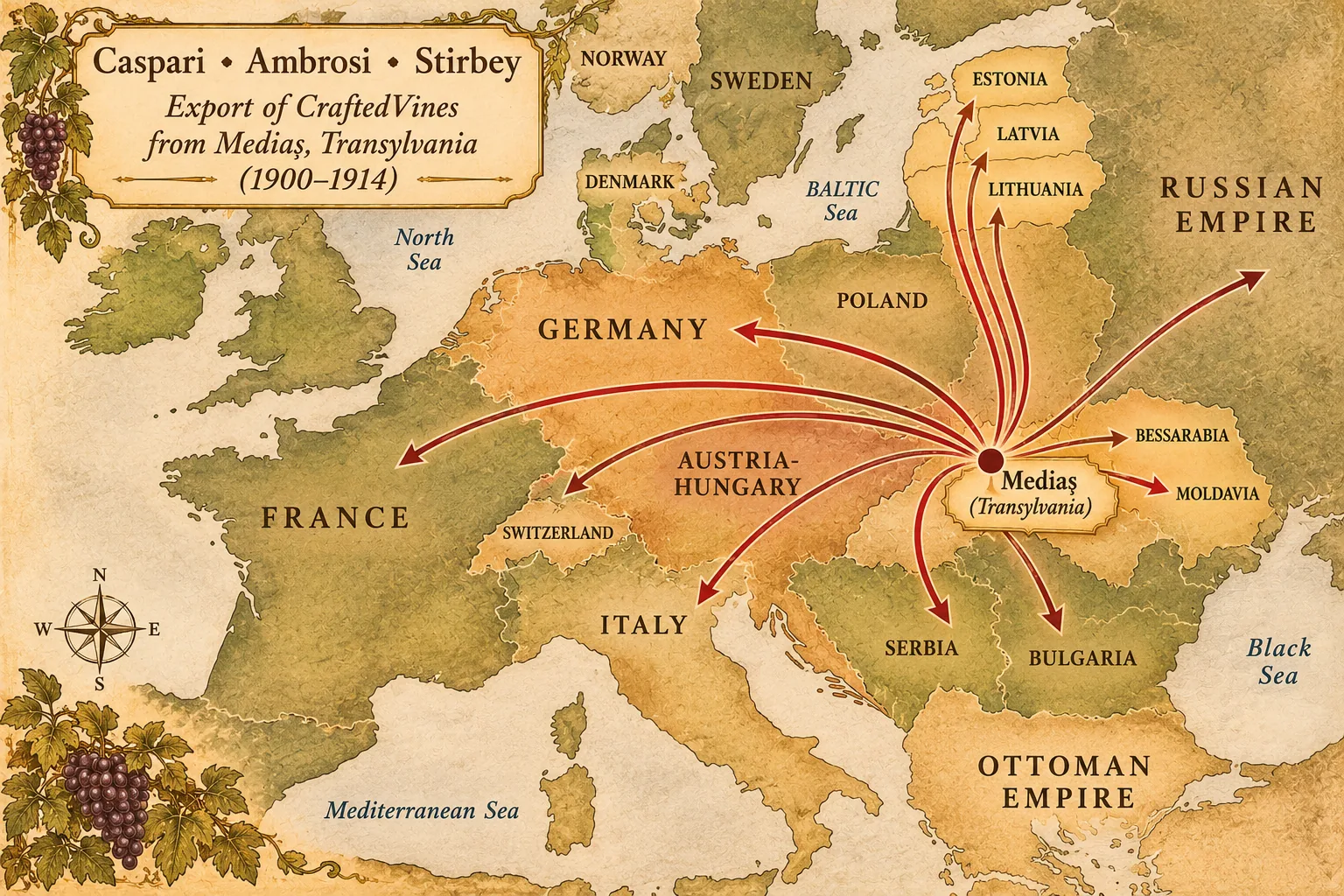
The sales network is the most spectacular part of the file. Caspari places his billboard with the earth globe and the vine in most train stations of the monarchy, publishes announcements in every specialist magazine and distributes thousands of catalogues each year, with prices for all the important wine-growing regions of Europe. He delivers by train wagon towards Austria, Hungary, Oltenia and even Russia, almost reaching the border of Asia. Before the First World War he owns 1,000 yokes of open field, extending as far as Oltenia, where he has branches of the company. Orders come from barons and princes: Inczedy, Liechtenstein, Szapary, Bussell — whose letters are reproduced in the catalogue. In 1939–1940 and 1940–1941 the house’s catalogues are still being printed, now under the name «Caspari, successor Iosif Höfner».
Caspari–Ambrosi–Știrbey · Export 1900–1914
Știrbey, Ambrosi and the road to Romania
The house’s Romanian connection runs through the nurseries of Prince Barbu Știrbey. In 1905 «Furnica» magazine publishes an advertisement for the American vine nurseries at Drăgășani, «under the direction of Mr. Fr. Caspari (Mediaș)»: vines with «a high take, vigour, absolute graft union», delivered free to any railway station, with free packaging, through a central sales office in Bucharest, Calea Victoriei 121.
In the same year the nurseries print their preface in a railway timetable: «Entering the third year of our nurseries’ existence…». The text describes stratification grafting, the selection of rootstocks and Romanian grafts, and advertises the ungrafted vines from the «great mother nurseries» on the Buftea estate. A dispatch note of the Știrbey nurseries at Buftea — form no. 2588, with fields for advance, cash on delivery and credit — preserves the vines’ journey by rail to Mediaș. In the 1907–1908 catalogue Caspari presented himself as «diploma oenologist, director of the vine plantations of Prince Barbu A. Știrbey in Romania, former viticulture commissioner of Târnava Mare county»; in 1931 the booklet «Planting and caring for the vineyards» called him «the former director of the vine nurseries of Prince Știrbey in Romania».
In the same town Michael Ambrosi Sen. (1862–1933) builds a parallel business: president of the Viticulture Commission, author of «Podgoreanul. Priceput Călăuză» (1906, 1913) and of leaflets on a new grafting process (1910, revised 1928), «associated with and director of the nurseries of Prince B. Știrbey at Buftea» and author of the article on the Știrbey nurseries at Buftea (1909). At Aiud, in Alba, the Ambrosi & Fischer nursery operated, and in the early 1920s Ambrosi gave Fetească regală its name. The book speaks of «the two pioneers of replanting Europe with grafted vines, Caspari and Ambrosi».
Az emberek
Akik viselték a nevet
21 octombrie 1858–1935
Friedrich Caspari
Szőlőtermelő, tanár, az erdélyi filoxéra elleni védekezés biztosa
A textilkereskedő Carl Josef Caspari második gyermeke, 1858. október 21-én született Mediașban. A Mediași Evangélikus Gimnázium (1877), egy év katonai szolgálat, tartalékos hadnagy (1879), a Sibiu-i Pedagógiai Kollégium, tíz év magántanárkodás évi 400 forintért, valamint tanítás egy szakiskolában 1884 és 1890 között. 1891-ben, 33 évesen egyetlen év alatt fejezi be a Viena melletti szőlészeti kollégiumot. Erdély filoxérabiztosává válik, évi 2000 korona javadalmazással, majd 1902-től a Kokel-völgyi oltótelep tulajdonosa, amerikai oltott vesszők importőre és termelője, raktáraiban akár négy millió vesszővel. 1907-ben visszavásárolja a Honterus utcai szülőházat. Az 1907–1908-as katalógus „a Știrbey Barbu A. herceg romániai szőlőtelepítéseinek igazgatójaként” mutatja be. A ház brosúrája „tanárnak, okleveles borásznak, a Știrbey herceg pincészetei igazgatójának, a Szász Borügyi Bizottság szakértő tagjának, szőlőtermelőnek és a filoxéra elleni védekezés biztosának” nevezi.
Mediași textilkereskedő és Friedrich Caspari apja. 1868-ban, amikor fia tízéves lett, elkezdte építeni saját házát a Honterus utcában. Jósága és megértő természete vezetett a ház, a telek és a mechanikus malom elvesztéséhez — ez a pillanat indította el a fiú ígéretét, hogy visszahozza a házat a családba. Születési és halálozási dátumai nem ismertek, és a forrásokban csak ez a két tény révén szerepel.
Carl Josef Caspari felesége és Friedrich édesanyja. A ház brosúrája egyetlen részlettel jellemzi, de az meghatározó: vidám és derűs természetű volt, hangjával töltötte meg a házat, így a gyerekek soha nem érezték a család pénzügyi gondjait. A szigorú apa szerepét elutasító férjével együtt szeretettel és a hagyomány tiszteletével nevelte gyermekeit. Születési és halálozási dátumai, valamint leánykori neve nem ismert.
Friedrich Caspari unokatestvére és felesége, üzlettársa
Friedrich Caspari unokatestvére és felesége. Hozzájárulása az üzlet részeként dokumentált: segített neki vezetni a céget, és az első raktárépületek mellett megjelentek a bortároló pincék és a ládaraktárak. A brosúra nem ad más adatot róla — sem a házasság évét, sem életadatait, sem a gyermekeket. A rekonstrukcióban a Caspari-dosszié egyik kevés női neve marad, és az egyetlen, amely kifejezetten az üzlet termelési oldalán jelenik meg.
A család utolsó mediași leszármazottja, a város díszpolgára
A Caspari család utolsó mediași leszármazottja és Mediaș város díszpolgára. 2005-ben, a központi negyed Buresch-házának felújítása során mesélt a szerzőnek a család történetéből egy részt, és adta át neki az első dokumentumokat — az a pillanat, ahonnan az egész rekonstrukció elindult. A könyv az ő emlékére jelent meg: „Maia Caspari asszony, Mediaș város díszpolgára, a család utolsó helyi leszármazottja, aki sajnos már nincs közöttünk”. A ház brosúrája „Mariane Caspari”-nak nevezi; mindkét forma szerepel a kötetben, és a megbízóval egyeztetni kell.
Szőlőtermelő, a Szőlészeti Bizottság elnöke, szőlészeti szakkönyvek szerzője
Európa oltott vesszővel való újratelepítésének második úttörője, Friedrich Caspari kortársa és városlakója. A Szőlészeti Bizottság elnöke volt, amelynek 1909-es jelentése fennmaradt, a mediași Ambrosi faiskolák és pincészetek tulajdonosa, a „Podgoreanul. Priceput Călăuză” című könyv (1906; 1913) szerzője, valamint az „egy új oltási eljárásról” szóló röplapoké (1910, átdolgozva 1928) és a „Pepinierele Principelui Știrbey de la Buftea” (1909) cikké. A könyvben „a Buftea-i B. Știrbey herceg faiskoláinak társtulajdonosa és igazgatója” volt. Leszármazottai szerepelnek a kötetben: Michael Ambrosi Jun. (1880–1940), Dr. Alfred Ambrosi (1895–1974) és Hans Ambrosi (1925–2012). Az 1920-as évek elején ő adta a Fetească regală nevét, Aiudon, Albában pedig az Ambrosi & Fischer faiskola működött.
Román herceg, a Drăgășani-i amerikai vesszőfaiskolák és a buftea-i birtok tulajdonosa
Az a román herceg, akinek neve azokon a dokumentumokon szerepel, amelyek a Caspari-házat Romániához kötik. Drăgășani-i amerikai vesszőfaiskoláit 1905-ben „Fr. Caspari úr (Mediaș)” irányította: a „Furnica” hirdetése, a borító és az 1905. júniusi vonatmenetrend előszava ezt minden alkalommal kimondja. A buftea-i birtokon álltak azok az anyafaiskolák, ahonnan az oltatlan vesszők érkeztek, és a Știrbey Buftea faiskolák egy szállítólevele megőrzi útjukat Mediașig. Az 1907–1908-as katalógusban Caspari a Știrbey Barbu A. herceg romániai szőlőtelepítéseinek igazgatójaként mutatkozik be. A források nem adják meg a herceg életadatait.
A név, amely Friedrich Caspari után átveszi a céget. Az 1939/1940-es és 1940/1941-es katalógusok a faiskola jogutódjaként mutatják: „Rebschule Caspari, Nachf. Josef Höfner” és „Pepiniera Caspari succesor Iosif Höfner”, București-i irodával a Str. Sirenelor 29. alatt, a faiskolával pedig Mediașban, a Str. Nouă 3. alatt. A bukaresti fiók egy rendelési űrlapja ugyanezt a formulát őrzi. A források nem adnak életrajzi adatokat.