
1206–1651
Vines attested in the area
Intensive vine cultivation is attested in the Mediaș area from 1206. Eight centuries before the wine metropolis, the territory was already a wine-growing one.
Detail
Mediaș · Transylvania · since 1651
Here wine was currency, and one name — Caspari — carried grafted vines from the Târnava valley almost to the border of Asia. We are rebuilding a house, a grape variety and an archive.
Manifesto
We are not selling a legend, we are reconstructing it. Mediaș called itself a wine metropolis, and the volume behind this site considers it the only city of its kind in Europe. The Caspari family turned grafting into an industry: four million grafted vines in its deposits, thousands of catalogues sent out every year, train wagons towards Austria, Hungary, Oltenia and Russia. Today the archive of that house sits in a folder of documents — billboards, labels, leaflets, envelopes, a price catalogue from 1907 and the family chronicle running from 1651 to 1983. We read them, show them and use them as evidence: every bottle bearing the Caspari name funds the restoration of the house on Honterus Street, the museum and the reopening of the cellar.
The Chapters
From the Weinland region to the house bought back in 1907, to the ties with Știrbey and Ambrosi, and to the archive that surfaced during a renovation in 2005.
The whole storyChronology
Drag or use the arrow keys to walk the milestones from 1651 to today.
Replanting Europe1206 01 / 18
Drag, scroll or use the ← → keys to walk the chronology. Every milestone can be opened.
Replanting
American rootstock, grafting, vine schools and a sales system that carried vines from the Târnava valley into the stations of the monarchy and the plains of Oltenia.
Read the dossierPhylloxera, the root aphid from North America, reached Europe in the second half of the nineteenth century. Old vineyards withered on their feet, year after year, from south to north-east. There was no treatment: only replacement.
The answer was an operation of plant engineering: resistant American rootstock grafted with the European variety. In Mediaș, Caspari built the nursery and the “Kokeltaler erste Rebveredlungs-Anlage”, the first vine-grafting facility of the Kokel valley, and became commissioner for combating phylloxera in Transylvania.
The Namen- und Preisverzeichnis catalogues of 1907/08 and 1939/40 carried the name across Europe. Freight wagons, letterhead envelopes and letters of thanks — Inczedy, Liechtenstein, Szapary, Bussell — are the evidence of an export that replanted the continent.
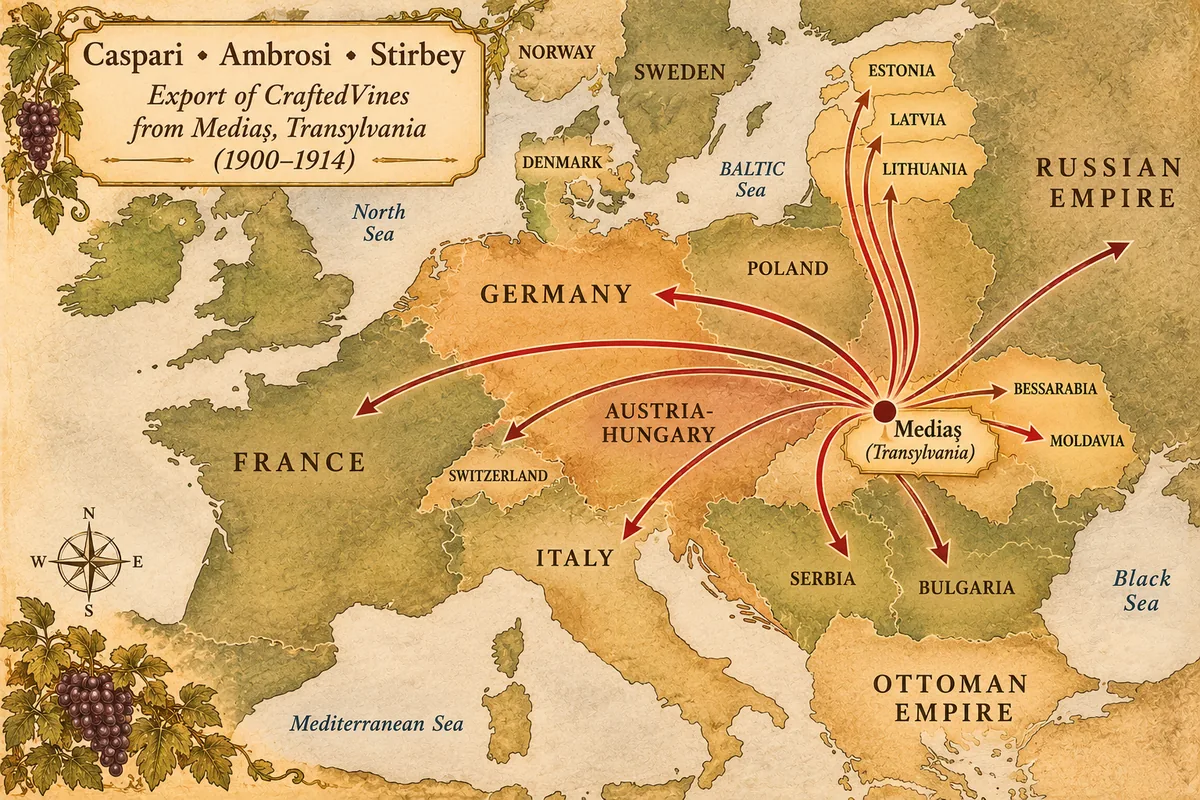
Routes of grafted vines from the Kokel valley to the vineyards of Europe, after the export catalogues.
We did not sell wine. We sold the future of the vine.
Letters of thanks
«Perhaps no other saxon from Transylvania was born with the craft of wine processing and the cultivation of wine like FRIEDRICH CASPARI, professor, diplomat oenologist, director of Prince Stirbey wineries, expert member of the Saxon Wine Commission, viticulturist and commissioner for combating phylloxera in Transylvania.»
«The Caspari name is known for the replantation of healthy vineyard in Europe after the devastation caused by phylloxera at the beginning of the 20th century.»
«I am very pleased with the noble vine planted in the spring…»
«I am happy to tell you that the vines grafted this spring have caught well and they are developing wonderfully so that I am extremely satisfied with the results.»
«I am completely pleased with the grafted vines delivered by you. The 2000 pieces of vines grafted in 1906 caught well and grown lovely. From the ones bought in 1907, I have found a very small loss. In the future, I will only buy from you.»
«Riesling and a special type of wine which could be found only in Medias, “Aurul Tarnavii”. Whoever wanted to savor the wine “Aurul Tarnavii” had to order it from the Caspari cellar.»
«Medias wine metropolis would not have existed without Friedrich Caspari, because trough him the viticultural region of the Tarnava valley was given an excellent personality and a pioneer spirit which had an extraordinary impact on reestablishing the damaged vineyards.»
«With the Caspari wine that you bought or received, you contribute to the rebirth of a legend and fulfill the wish of the last descendant of the Caspari family which lives in Medias, Mariane Caspari, that to keep the living memory of a family with tradition in Medias.»
«Many vineyards that stood unproductive for whole years are today replanted with grafted American vines, and whole fortunes are reborn on the hills that the phylloxera plague had turned into sterile fallows.»
Relations
Two families tied to the Caspari file: the prince whose vines came from Drăgășani and Buftea, and the second pioneer of the replanting, Michael Ambrosi.

The American vine nurseries at Drăgășani and Buftea
In 1905 the advertisement in «Furnica» magazine and the cover of a railway timetable say it plainly: the American vine nurseries of Prince Barbu Știrbey at Drăgășani were directed by «Mr. Fr. Caspari (Mediaș)». The timetable’s preface, signed by the nursery in June 1905, describes the grafting method and the mother nurseries at Buftea; a dispatch note of the Știrbey nurseries at Buftea preserves the vines’ journey by rail to Mediaș. In the 1907–1908 catalogue Caspari presented himself as director of the vine plantations of Prince Barbu A. Știrbey in Romania, and in 1931 as their former director.


Michael Ambrosi Sen. (1862–1933), the second pioneer
A contemporary and fellow townsman of Friedrich Caspari, Michael Ambrosi Sen. was president of the Viticulture Commission (the 1909 report), author of «Podgoreanul. Priceput Călăuză» (1906; 1913) and of leaflets on a new grafting process (1910, revised 1928). He was «associated with and director of the nurseries of Prince B. Știrbey at Buftea» and wrote about them in 1909; at Aiud, in Alba, the Ambrosi & Fischer nursery operated. In the early 1920s, Fetească regală was named by Ambrosi. The volume calls the two men «the pioneers of replanting Europe with grafted vines».
1868 · 1907 · today
A house begun by a father in 1868, lost out of too much kindness, bought back in 1907 by the son who had made himself a promise. Today it carries the address of the Caspari firm.
The house documentsIn 1868, when Friedrich turned ten, Carl Josef Caspari began building his own house on Honterus Street in Mediaș. The textile merchant was fulfilling a wish postponed for too long: a family home, in a town where the Caspari name was already two centuries old. There was singing in the house; Josefa, the mother, had a jolly temper and filled her children with her voice, so that they never felt the family’s hardship.
The joy did not last. The father’s kindness and his understanding nature led to the loss of the house and of the land with the mechanical mill — a ruin that the family’s brochure states plainly, without hiding the blame. The boy was marked by it: he promised himself that one day he would bring the house back into the family’s property. Meanwhile he finished the gymnasium (1877), taught for ten years on a salary of 400 florins, completed the viticulture college at Klosterneuburg (1891), became commissioner for phylloxera in Transylvania and, from 1902, owner of the first grafting facility in the Kokel valley.
In 1907 — the year the house’s catalogue begins to collect letters of thanks from barons and princes — Friedrich Caspari bought the parental house. The promise was kept. The photographs in the archive show the house in 1907, with the firm written above the portal («FR. CASPARI»), and in 1912, framed by the Trumpeters’ Tower. Since then the house has remained the family’s address: the 2022 brochure prints «Str. J. Honterus No. 6, 551019 Mediaș» on its back cover.
The same brochure says what comes next: the earnings from the house’s products and from the «legend» are invested in renovating the Caspari house, in setting up the museum and in reopening the cellar — and, why not, in the vineyards around Mediaș. The house of 1868 is not a stage set for the story; it is the reason the story is being printed again.
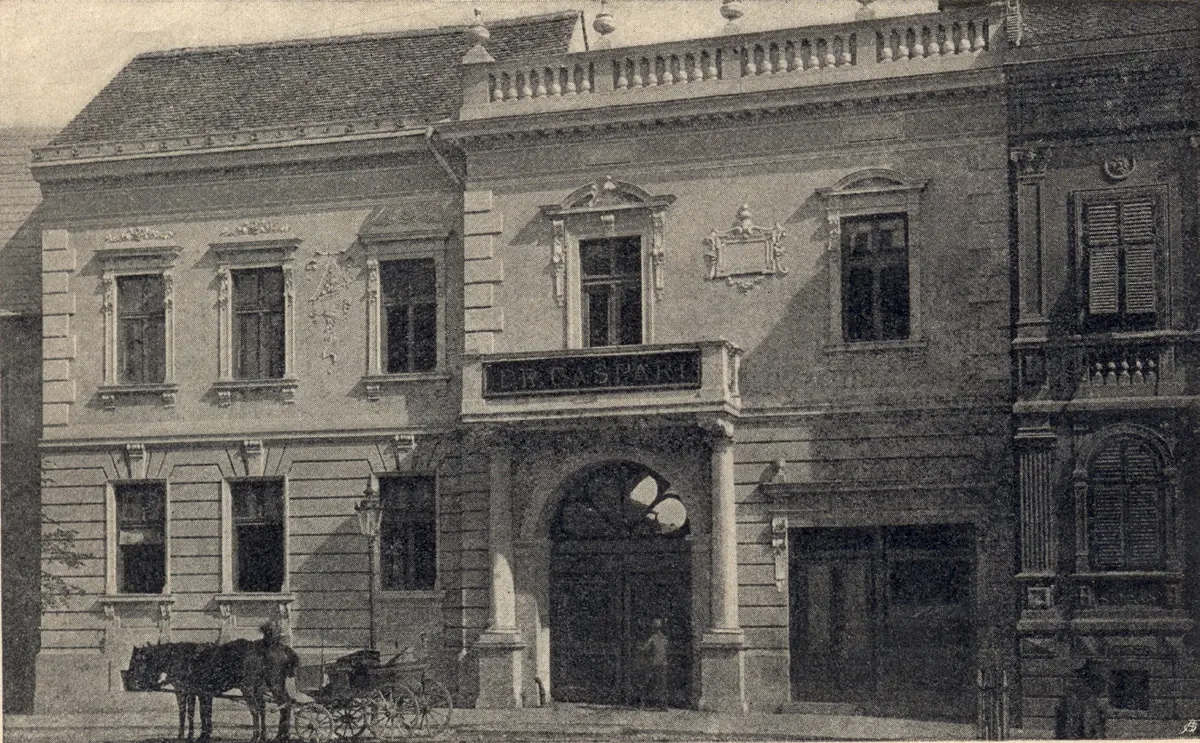

The archive
Billboards, labels, 1907 leaflets, an advertisement of 13 February 1909, envelopes from 1938, a freight form and seven pages of Furnica magazine.
The whole archive
The cover of the Caspari family chronicle, covering the years 1651–1983: the oldest and most extensive document in the archive.
Source Colecția Caspari

The portrait of Friedrich Caspari, with his years in the caption: the portrait of the house's founder in the archive.
Source Colecția Caspari

The Caspari billboard used in Mediaș between 1902 and 1918; the archive holds two photographic variants of the same board.
Source Colecția Caspari

The advertisement of Prince Barbu Știrbey’s nurseries at Drăgășani in «Furnica» of 1905, «under the direction of Mr. Fr. Caspari (Mediaș)»: American vines with «high take, vigour, absolute graft union», reduced prices, delivery free to any railway station and free packaging. Central sales office: Bucharest, Calea Victoriei 121, and W. Staadecker. Copy at BCU Cluj-Napoca.
Source BCU Cluj

The preface of the 1905 railway timetable, signed by Prince Barbu Știrbey’s nurseries at Drăgășani (June 1905), «under the direction of Mr. Fr. Caspari (Mediaș)». The text announces the third year of existence, grafting with Romanian rootstocks and the vines from the mother nurseries at Buftea; the timetable was printed by Ralian and Ignat Samitca, Craiova.
Source Arhiva Domeniilor Știrbey
The cover of the 1905 railway timetable, printed as an advertisement for Prince Barbu Știrbey’s American vine nurseries at Drăgășani, «under the direction of Mr. Fr. Caspari (Mediaș)»: two hemispheres of grape bunches, like a map of the grafted vine.
Source Arhiva Domeniile Știrbey (fotografie din colecția Caspari)
The documents are ordered chronologically, oldest first. The archive gathers material assembled between 2005 and 2021; the originals are kept in Mediaș, and the selection here can be consulted on request.
Explore the archiveThe wines
The variety Friedrich Caspari called «the grape of the future» and the wine you could order only from the Caspari cellar.
All the winesThe Caspari house
A special type of wine «which could be found only in Mediaș», sold exclusively through the Caspari cellar
The house's brochure says that whoever wanted to taste «Aurul Târnavei» had to order it from the Caspari cellar. The historical label carries the Romanian name together with the equivalents «Kokelgold» and «Küküllő Aranya». The variety, the recipe and any year are unknown.
About the wineThe Caspari house
The house's favourite variety, described by Friedrich Caspari as «the grape of the future»; a reconstruction after the historical labels
Caspari produced a Neuburger regarded as remarkable and experimented with it in his cellar. The surviving labels show the variety also existed as a commercial product. We have no vintage and no tasting description in the sources, and we invent neither.
About the wineThe Caspari house
A varietal wine of the Caspari cellar, attested by the label «Caspari Riesling»
The only classic European variety explicitly named in the sources alongside Neuburger. The book attaches to it no vineyard, no year and no tasting description; we present it as a historical attestation, not a vintage.
About the wineThe Caspari house
A historical label of the house, with the mention «Specialitate Neuburger»
The commercial variant of the Neuburger, as it appears on the labels preserved in the archive. Its presence shows that the variety was not merely Friedrich Caspari's personal preference but a wine released under its own name.
About the wineThe wines of the house are produced in small batches. Please drink responsibly.
Context
The Caspari project is part of Core of Transylvania, the multi-concept strategy promoting Mediaș worldwide as a cultural and tourist destination: wine, Hermann Oberth, methane gas and the citadel, plus the general shop.
Visit
Honterus Street, the cellars beneath the city and a wine metropolis you can read on the ground, document by document.
The cellars, the house and the archive are visited in small guided groups. Write to us a few days in advance.
Write to us