Phylloxera destroyed the vineyards of Europe, and the answer came from the Târnava valley: American rootstock, grafting, vine schools and a sales system that carried vines into the stations of the monarchy.
Phylloxera
On his return from Klosterneuburg, Friedrich Caspari finds the vineyards of Europe and of the Mediaș area laid waste by phylloxera. This is not a local crisis: the insect, which had arrived from North America, was destroying European vineyards, and in Transylvania its effects become so grave that replanting can no longer be left to each owner. A state office is created, and the discussion moves from «what do we do with the vine» to «who is responsible for restoring the vineyards». In this context a teacher with a bent for agronomy and a merchant with ambition suddenly become people of public importance. The documents preserve the moment: an article signed by Friedrich Caspari as commissioner for phylloxera of Târnava Mare County.
The commissioner
Caspari applies for the post of commissioner for combating phylloxera in Transylvania, is accepted and receives a salary of 2,000 crowns a year. For ten years he replants vineyards, forms and trains viticulturists, holds lectures and searches for the ideal solution. This is the period in which he learns the problem at scale — not just how to plant a vineyard but how to restore a region. A solution is found, but he cannot use it: it would be a conflict of interest between the public office and his own business. That is why the dissolution of the post in 1902 is experienced by him as a relief, not a loss. From that moment he can do what he had long wanted: plant his own vine school.
1902: American grafting
In 1902 Caspari takes the biggest risk of his life: he imports American grafted vines in order to produce them himself and multiply them in large quantities. The technical stake is simple and enormous: the American rootstock resists phylloxera, the European graft gives the wine. The risk pays off — his deposits come to hold up to four million grafted vines, and he becomes one of the richest men in Mediaș. But above all he gains a title: «viticulture pioneer», because after planting the rootstock gardens he established vineyard schools for grafted vines. This is the moment when a producer becomes a technical school.
The nursery of the Kokel valley
The institution has a name that fixes the place: «Kokeltaler erste Rebveredlungs-Anlage» — the first vine-grafting facility of the Kokel valley, that is of the Târnava valley, under the trade name Caspari Fr. The name appears on the price catalogue and on the billboard, in German and in Hungarian: «A kőkellemti első szőlőoltványtelep». It is a case of agro-industrial branding avant la lettre: not «Caspari's nurseries» but «the first grafting facility» of an entire valley. What comes out of this facility is not only vines but trained people, a price catalogue with two hemispheres on its cover and a network of vine schools. In the drought years Caspari also solves water: he builds a water wheel on the Bulgarian model and brings water from the Târnava through channels kilometres long.
The export
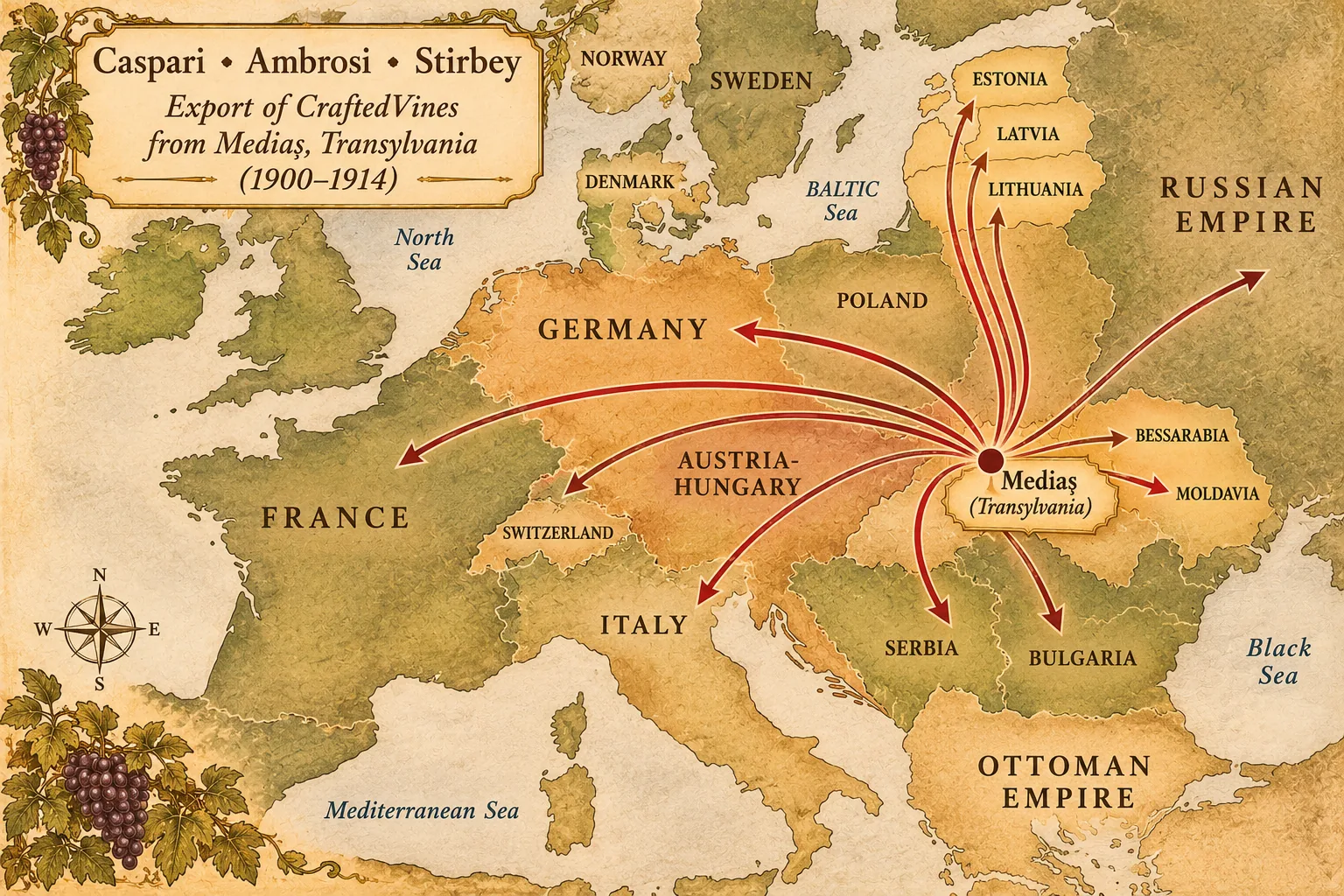
The sales network is the most spectacular part of the file. Caspari places his billboard with the earth globe and the vine in most train stations of the monarchy, publishes announcements in every specialist magazine and distributes thousands of catalogues each year, with prices for all the important wine-growing regions of Europe. He delivers by train wagon towards Austria, Hungary, Oltenia and even Russia, almost reaching the border of Asia. Before the First World War he owns 1,000 yokes of open field, extending as far as Oltenia, where he has branches of the company. Orders come from barons and princes: Inczedy, Liechtenstein, Szapary, Bussell — whose letters are reproduced in the catalogue. In 1939–1940 and 1940–1941 the house’s catalogues are still being printed, now under the name «Caspari, successor Iosif Höfner».
Caspari–Ambrosi–Știrbey · Export 1900–1914
Știrbey, Ambrosi and the road to Romania
The house’s Romanian connection runs through the nurseries of Prince Barbu Știrbey. In 1905 «Furnica» magazine publishes an advertisement for the American vine nurseries at Drăgășani, «under the direction of Mr. Fr. Caspari (Mediaș)»: vines with «a high take, vigour, absolute graft union», delivered free to any railway station, with free packaging, through a central sales office in Bucharest, Calea Victoriei 121.
In the same year the nurseries print their preface in a railway timetable: «Entering the third year of our nurseries’ existence…». The text describes stratification grafting, the selection of rootstocks and Romanian grafts, and advertises the ungrafted vines from the «great mother nurseries» on the Buftea estate. A dispatch note of the Știrbey nurseries at Buftea — form no. 2588, with fields for advance, cash on delivery and credit — preserves the vines’ journey by rail to Mediaș. In the 1907–1908 catalogue Caspari presented himself as «diploma oenologist, director of the vine plantations of Prince Barbu A. Știrbey in Romania, former viticulture commissioner of Târnava Mare county»; in 1931 the booklet «Planting and caring for the vineyards» called him «the former director of the vine nurseries of Prince Știrbey in Romania».
In the same town Michael Ambrosi Sen. (1862–1933) builds a parallel business: president of the Viticulture Commission, author of «Podgoreanul. Priceput Călăuză» (1906, 1913) and of leaflets on a new grafting process (1910, revised 1928), «associated with and director of the nurseries of Prince B. Știrbey at Buftea» and author of the article on the Știrbey nurseries at Buftea (1909). At Aiud, in Alba, the Ambrosi & Fischer nursery operated, and in the early 1920s Ambrosi gave Fetească regală its name. The book speaks of «the two pioneers of replanting Europe with grafted vines, Caspari and Ambrosi».
人物
承袭这个名字的人
21 octombrie 1858–1935
Friedrich Caspari
葡萄种植者、教授、特兰西瓦尼亚抗击根瘤蚜专员
纺织商人 Carl Josef Caspari 的第二个孩子,1858年10月21日生于 Mediaș。就读 Mediaș 福音派中学(1877),服役一年,任预备役中尉(1879),进入锡比乌师范学院,做了十年私人教师,年薪400弗罗林,并在1884至1890年间于一所职业学校任教。1891年,33岁的他用一年时间读完了维也纳近郊的葡萄种植学院。他成为特兰西瓦尼亚的根瘤蚜专员,年薪2000克朗;随后自1902年起,成为 Kokel 河谷嫁接场的所有者,进口并生产美国嫁接葡萄藤,库存最多达四百万株。1907年,他买回 Honterus 街的祖宅。1907–1908年的产品目录称他为“罗马尼亚 Barbu A. Știrbey 亲王葡萄园的主管”。家族小册子则称他为“教授、持文凭的酿酒学家、Știrbey 亲王酒庄的经理、撒克逊葡萄酒委员会的专家成员、葡萄种植者,以及抗击根瘤蚜的专员”。
Friedrich Caspari 的表妹与妻子。她对生意的贡献是有文献记载的:她帮他经营公司,最早的仓储建筑旁也出现了存酒的地窖和装板条箱的库房。小册子没有提供其他信息——没有结婚年份,没有生卒年月,也没有子女。在重建中,她仍是 Caspari 卷宗里少数几个女性名字之一,也是唯一明确出现在生意生产环节中的一个。
Friedrich Caspari 之后接手公司的名字。1939/1940年和1940/1941年的目录显示他是苗圃的继承人:“Rebschule Caspari, Nachf. Josef Höfner”和“Pepiniera Caspari succesor Iosif Höfner”,办事处设在布加勒斯特 Str. Sirenelor 29,苗圃设在 Mediaș, Str. Nouă 3。布加勒斯特分部的一张订购单也保留着同样的写法。资料没有提供他的生平信息。